
'Bukhari's case falls into that rare category where the precise determination of the killer as well as the motive can only be guessed vaguely, not determined with certainty,' says Mohammad Sayeed Malik, the distinguished doyen of the Kashmiri media.

Noise levels began to climb and everyone else in the room stared agape as the fracas escalated, including the trio of accused at the back. Peter, Sanjeev and Indrani stood at the edge of their enclosure craning to see the spectacle.
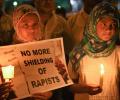
Sanji Ram and Vishal Jangotra, who were chargesheeted by the crime branch of Jammu and Kashmir Police in the case, claimed that the police had miserably failed to conduct a "fair and effective" probe and alleged that "tainted" officers were part of special investigation team which probed the matter.

He also said the whole world knew that the BJP alone knows how to run the nation.

How much more gray or bald would Inspector Alaknure have become when we see him next? Will Peter still be wearing white shirts and khaki trousers and eating large lunches? Will Judge Jagdale be still in charge of the case? Who will be the prime minister when Alaknure appears in court next?

After ten minutes no one could keep track of the legal team's questions on the geography of the route Sandeep Patil took on his Pulsar Bajaj motorcycle, on the morning of April 25, 2012. Not the judge. Or the onlookers. Least of all Patil.

Can Sidharth Malhotra and Sonakshi Sinha bring back the magic created by Rajesh Khanna and Nanda in the 1969 original?

It would seem that Indrani's application was not something prepared or maybe even sanctioned by her lawyers and was a courtroom enterprise she had embarked on by herself, perhaps not realising it distracted from the main business of the trial and didn't help her cause.

'Could the Khar police and the CBI have tinkered with the driver's call data records?' 'And did their fiddling with the information not make it that they were tampering with the lives of people that were in the balance as a result of this case?'
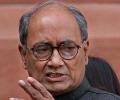
Stepping up attack on the Bharatiya Janata Party over Asaram Bapu controversy, Congress leader Digvijay Singh on Sunday targeted Narendra Modi, asking why he has not taken action on the report of a judicial commission which probed the mysterious death of two boys at the godman's Gujarat ashram.
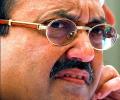
Politician Amar Singh was on Wednesday questioned for nearly two hours by a special team of Delhi Police probing the Sunanda Pushkar case after he had recently claimed that she had spoken to him about the Indian Premier League controversy a couple of days before her death.

We look at the movies that made Kangana Ranaut a star.
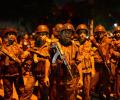
'I have noticed how a certain country wants to establish the presence of ISIS in Bangladesh.' 'Are these terrorists working under some religious inspiration or they are being lured by an obnoxious amount of money?' 'For some mysterious reasons, no action is taken by the government against suspicious organisations.'

Shashi Tharoor was intensely questioned on Monday night over two hours by a special team of the Delhi police on the circumstances leading to the mysterious death of his wife Sunanda Pushkar a year back and her spat with Pakistani journalist Mehr Tarar over her links with the Congress member of Parliament.
Opposition parties continued their dharna for the third day on Thursday in the state assembly, demanding a Central Bureau of Investigation probe into the mysterious death of an upright IAS officer, forcing its adjournment till March 23, as protests over the death persisted across the state.

This week was the first time Peter and Indrani appeared in court no longer married, footloose and fancy free once again, even if in jail.

Ever since Indrani's bail plea was denied by the judge her security has been stepped up. The message was clear. If she felt that unsafe she could get all the security she needed. But in jail she stayed.

The attempts to unearth the document started getting more and more frantic. The clerks began to flip pages of files full of documents, some hand written, some bearing thick seals or multiple stamps, some in Hindi, some in Marathi. Several junior lawyers joined in, perusing different files and dockets. But in spite of the best of efforts the document was not to be found.

A look at few gurus who have attracted controversy in recent times.

It all started from Mumbai. Now, Khan's fan base has spread from the US, UK and West Asia to Malaysia, Indonesia, Japan, Germany, Egypt, Jordan, Morocco, Kuwait and Palestine. Of the top 10 Bollywood movies that earned the most overseas, seven had Khan in them.

Over the weekend and Labour Day, a change seemed to have come over the former secretary and her memory had all but deserted her. Not unexpectedly, Kajal Sharma had lost much of her exactness. Her vocabulary had shrivelled to four or five words.

Does Manmarziyaan feature in your list?

Sanjeev Khanna stepped out of his usual sort of absent-minded personality to actively 'log into' the hearing, following the testimony alertly, at times standing up in the accused box to catch all of what was being said. His co-accused Peter Mukerjea and Indrani Mukerjea were less attentive, but were not switched off either.

Delhi Police on Saturday said it is not going to question Congress MP Shashi Tharoor for now in connection with the mysterious death of his wife Sunanda Pushkar as it would first want to examine all other people related to the case and look into available evidence.
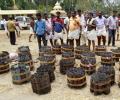
The police has registered a case against six persons, including members of temple managing committee and associates of firework contractors, on attempt to murder and other charges in connection with the Putttingal Devi temple fire tragedy, even as the toll rose to 109.

'Our Lockdown Life has a sort of schizophrenic, Dr-Jekyll-and-Mr-Hyde personality about it,' says Vaihayasi Pande Daniel.

Pasbola had a number of queries about the nails of the corpse found at Gagode Khurd. Did it have nails? Nails, in a case of strangulation, are key because they often have particles and skin beneath them to show the victim had been grasping something as s/he was strangled.

A look at few gurus who have attracted controversy in recent times.

Senior Congress leader Shashi Tharoor on Thursday praised Prime Minister Narendra Modi for his gesture of congratulating him after winning the Lok Sabha elections, saying he did not expect him to reach out after their "nasty" spat.

The Delhi Police, which has registered a case of murder in the mysterious death of Sunanda Pushkar, will send her viscera samples to a laboratory either in Britain or the US to identify the poison including whether it could be radioactive isotopes that cannot be detected in Indian labs.

The lesson Waghmare sternly received on Monday from CBI Investigating Officer K K Singh and CBI Prosecutor Bharat Badami about the way a witness must answer questions from the defence seemed to have had only a marginal effect on him. On Tuesday the timid former office boy still chose, unpredictably and remarkably, to answer many a question in the manner of his choosing. He told the room categorically that he had asked Indrani's former secretary Kajal Sharma not to forge Sheena Bora's signature on her resignation letter.

The onus for ordering a CBI probe into the Vyapam scam now rests with Supreme Court after the Madhya Pradesh high court on Wednesday deferred hearing on a state government's plea for an inquiry by the central agency, saying the apex court would hear similar petitions on Thursday.

'The ideal of justice is ingrained in every human being.' 'I truly feel that if we empower our forces, the rich and the powerful will lose their hold on them.' Additional Solicitor General Pinky Anand in an exclusive interview.

Congress leader Shashi Tharoor has once again been questioned in connection with his wife Sunanda Pushkar's death and the special investigation team probing the high-profile case may summon him again.

It is not often that Goswami's Nation-Wants-to-Know shows become material evidence in a murder trial no less. Nor was it something CBI Special Judge J C Jagdale was wildly enthused about. It had to be done because as he put it to CBI Special Public Prosecutor Kavita Patil caustically: "Your witnesses gave interviews to channels about a serious crime."

Naku Penta Naku Taka is a disappointment considering the promise it carried.

She continued to cry, harder, feebly dabbed her eyes with the handkerchief she had received, and declared painfully: "He is hurting my emotions!"

Over 300 angry relatives of Chinese passengers aboard the Malaysian airliner on Tuesday clashed with security personnel outside Malaysia's embassy in Beijing as China demanded the truth about the jet's mysterious crash.

'The wonderful thing about being a journalist is that when someone tries to muzzle your work, it's a badge of honour.' 'You know you've done something right,' Priyanka Pathak-Narain, the author of Godman To Tycoon: The Untold Story Of Baba Ramdev, tells Sunil Sethi.

Sircilla Rajaiah's daughter-in-law and three grandsons were found charred to death at his residence under mysterious circumstances early Wednesday and hours later the leader, his wife and son were taken into police custody for questioning.
